

About uMngeni
- Home
- About uMngeni

About uMngeni
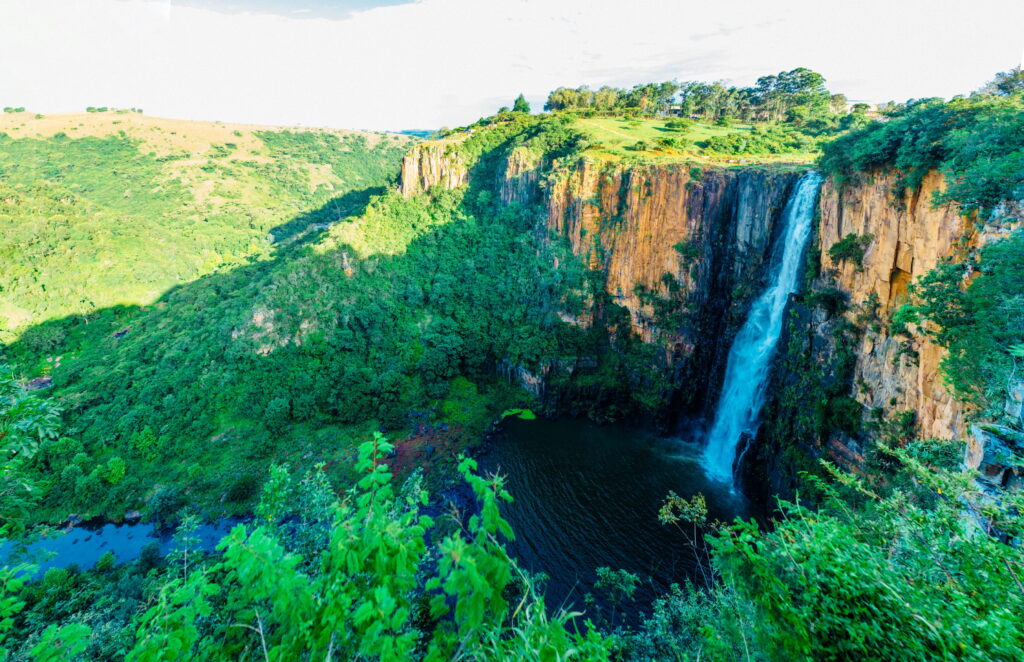
Howick’s origins date back to the mid-19th century when the British government allocated land in the KwaZulu-Natal Midlands. The town began as a dangerous ford across the uMngeni River, situated just above the 95-metre-high Howick Falls, known to the Zulu people as kwaNogqaza (“Place of the Tall One”).
Naming: It was named after Earl Grey, the British Colonial Secretary, whose family seat was Howick Hall in England.
Historical Significance: During the Anglo-Boer War, it was the site of a British concentration camp. On 5 August 1962, it became a focal point of South African history when Nelson Mandela was arrested on the R102 between Howick and Lidgetton.
GOVERNANCE & 2021 ELECTION RESULTS
• Democratic Alliance (DA): 13 seats
• African National Congress (ANC): 10 seats
• Economic Freedom Fighters (EFF): 2 seats
WARDS AND DEMOGRAPHICS
Population: Approximately 105,069 residents (2022 Census).
Racial Makeup: 66.7% Black African, 22.9% White, 7.6% Indian/Asian, and 2.3% Coloured.
Languages: IsiZulu (64.3%) and English (25.5%) are the primary languages spoken.
Geography: Covers 1,567 km² and includes urban hubs like Howick and Hilton alongside the rural Midlands farming areas.
VISION AND MISSION (CURRENT TERM)
Vision: “By 2035, the uMngeni Municipality will be a beacon of excellence and efficiency, delivering quality services, building safer communities and supporting sustainable socio-economic development”.
Mission: To improve skills capacity through people-focused development to deliver quality services and ensure inclusive socio-economic growth.
KEY PRIORITIES & OBJECTIVES
• Infrastructure Investment and Maintenance: To restore and expand road networks and utilities to support economic growth.
• Jobs and a Growing Economy: To foster local job creation through tourism, agriculture, and small business support.
• Waste and the Environment: To ensure a clean, sustainable environment through effective refuse removal and conservation.
• Responsive and Transparent Government: To promote accountability, fight corruption, and enhance municipal effectiveness.
• Building Safer Communities: To strengthen law enforcement and partnerships with community safety forums.
• Financial Viability: To ensure that the Municipality is well resourced to undertake the needs and requests of residents
TOURISM AND EDUCATION
Key Sites: The Howick Falls Precinct and the Nelson Mandela Capture Site are critical landmarks managed by the municipality to drive the local economy through tourism. uMngeni is a premier tourism destination in KwaZulu-Natal, leveraging its position within the scenic Midlands Meander to offer a diverse range of experiences from historical landmarks to high-adrenaline adventures.
WILDLIFE AND NATURE RESERVES
uMngeni Valley Nature Reserve (WESSA): A 900-hectare reserve situated just 1 km from Howick. It features spectacular views of the gorge below Howick Falls and is home to wildlife including zebra, giraffe, wildebeest, and various antelope like nyala and bushbuck.
Karkloof Conservation Centre: A critical site for birding enthusiasts, particularly known for its efforts in conserving the critically endangered Wattled Crane. It offers well-kept hides and pristine grasslands.
ADVENTURE TOURISM
Karkloof Canopy Tour: A world-class zip-line experience featuring 12 platforms and 10 slides through the indigenous Karkloof forest.
Hiking and Trails: Popular routes include the Falls2Falls 3-day slack-packing hike and various trails within the uMngeni Valley that offer rock climbing and abseiling.
Water Sports: The nearby Midmar Dam is a hub for canoeing, sailing, and the world-famous Midmar Mile swimming event.
TOWNSHIP AND CULTURAL TOURISM
Zulu Mpophomeni Tourism Experience (ZMTE): An award-winning community-based initiative in Mpophomeni Township.
Tours include:
• Visits to the Nokulunga Gumede Memorial and the Mpophomeni Museum
• Authentic Shisanyama culinary experiences.
HOTELS AND LODGINGS
EDUCATION
Learn More About uMngeni
In 1849, the Wesleyan Missionary James Archbell bought three farms above the northern bank of the uMngeni River. Title deeds of the original plots simply named the area “The Village on the uMngeni Waterfall”.
In 1850, the river crossing was moved to the dangerous but more convenient spot at the top of the Falls. This was less than 200 metre’s from where the river plunged over the cliff’s edge.
It was a treacherous spot, and many travelers and wagons were swept over the falls. With the increase in traffic to the north, the government decided to establish a village at the crossing and purchased part of James Archbell’s farm. In November 1850, a proclamation appeared in the Natal Government Gazette, offering 36 village allotments on the uMngeni Waterfall Drift for sale. This marked the beginning of the town. In choosing a name for the new town, government officials decided to honor their Secretary of State for the Colonies in London. He was Earl Grey and had recently acquired the title of Lord Howick. The name is derived from his ancestral home of Howick Hall in Northumberland, England. Two other towns were named “Howick” at the same time: one in New Zealand and the other in Ontario, Canada.
During the Anglo-Boer War from 1899 to 1902, the British established a concentration camp on the outskirts of the village. A monument to the women and children who died during their incarceration in the camp marks the location. A little-known fact about Howick (and nearby Karkloof) is that it is possibly the location of the first manned flight in the world. [3] Evidence exists that a John Goodman household flew a self-made glider in 1871 and again in 1875 on the outskirts of Howick, close to Karkloof. The actual distance flown and altitude achieved differ from source to source (some sources say the distance was 80 meters), but what can be verified is that the distance flown was further, and the duration also longer, than either of the flights made by Lilienthal or the Wright brothers. Today, there exists a memorial to Household’s achievement at Curry’s Post, also a small distance outside Howick.
The uMngeni Valley Ranch or Nature Reserve was established in the 1970s on the then outskirts of Howick by the Wildlife and Environment Society of South Africa (WESSA). The nature reserve consists largely of the deep valley cut by the Mngeni River below the Howick Falls into the surrounding sandstone. WESSA reintroduced game into the area, such as zebra and wildebeest (gnu), and established a number of huts for overnight accommodation. In December 1996, Nelson Mandela was awarded “The Freedom of Howick.” This followed his arrest some 34 years before, on 5 August 1962, on the main Durban-Johannesburg road, as it was then—more particularly, between Howick and Lidgetton West. [4] A small monument showing the site where he was arrested by the Security Police may be seen on the southern roadside of the R102 in a dip in the road. In recent years, Howick has expanded significantly following the establishment of a number of major retirement villages, such as Amberfield, Amberglen, Amber Valley, Amber Ridge, and Amber Lakes, that flank the Karkloof Falls Road.
Our Mission
uMngeni Municipality through people focussed development will improve its skills capacity in order to deliver quality services and ensure inclusive socio-economic growth.
Our Vision
By 2035, the uMngeni Municipality will be a beacon of excellence and efficiency delivering quality services, building safer communities and supporting sustainable socio-economic development.
Our Values
We prioritize the needs and aspirations of our residents, placing the community at the heart of all our decisions and actions. We strive to create an inclusive and supportive environment where every individual feels heard, respected, and valued.
Report Electricity Faults
To report:-
▪︎ Electricity outages
▪︎ Non-functional streetlights
▪︎ Non-collection of refuse
▪︎ Vehicle accidents
▪︎ Disaster caused by floods, fires, snow or fallen trees
To report:-
▪︎ If electricity in your area is the responsibility of Eskom. Please contact them on 0860 0037 566.
▪︎ If electricity in your area is the responsibility of the Msunduzi Municipality. Please contact them on 033 392 5029 / 080 000 1868.
▪︎ Water and sanitation are the responsibility of uMgungundlovu District Municipality. Please contact them on 0800 864 911 or 033 897 6766.
Report Electricity Faults
Electrical faults in uMngeni Local Municipality are handled by uMgungundlovu District Municipality.
Cnr Dicks & Somme Streets, Howick, Kwa-Zulu Natal.
(NB: The operating hours for vehicle licensing, driver’s licence renewals, and learner’s licence applications are 07:30 to 14:30. These sections stay open until 16:00 for other services like enquiries, collections, and forms.)